
Structural Rebar Detailing: Comprehensive Guide to Steel Standards, Shop Drawings & Optimization
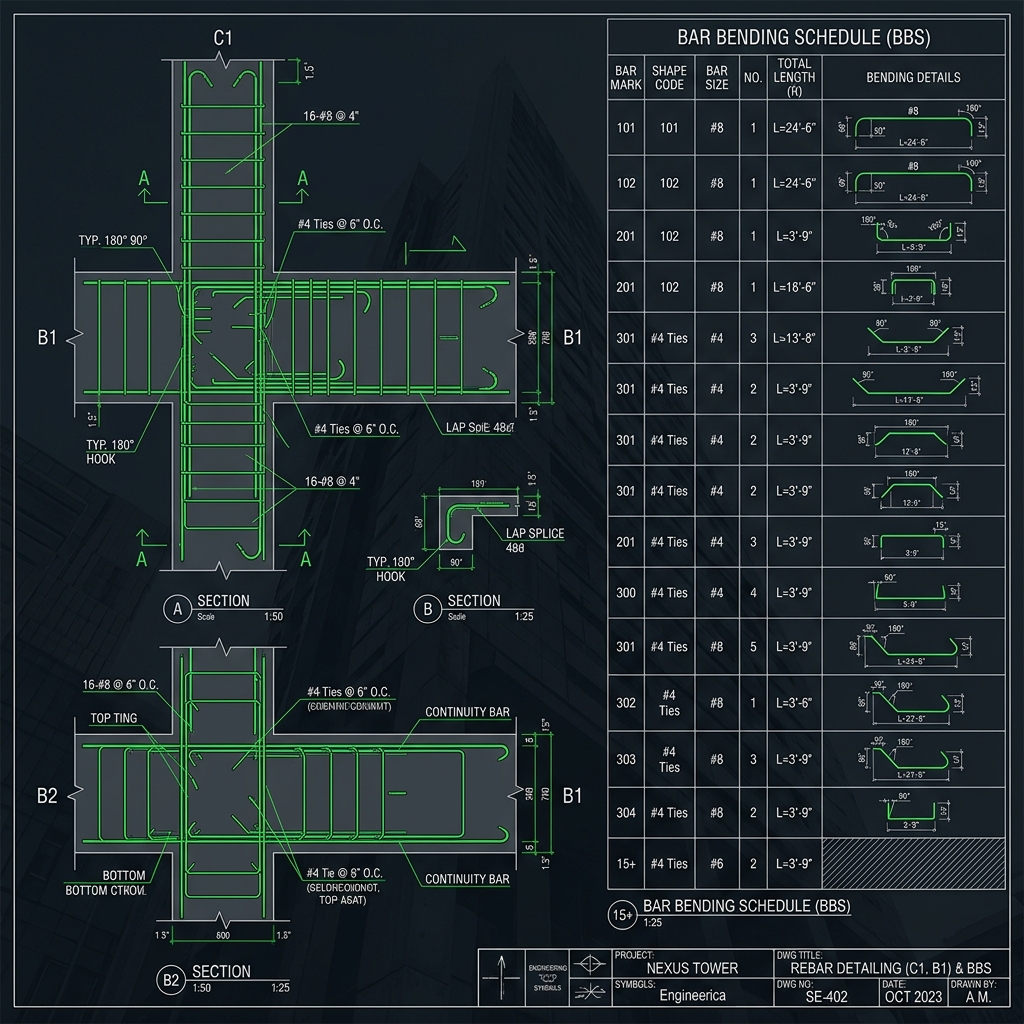
Reinforced concrete (RC) stands as the backbone of modern civil infrastructure—from high-rise residential towers and massive transport bridges to subsea tunnels and industrial energy facilities. However, a structural concrete design is only as robust and constructible as its underlying Structural Rebar Detailing.
Structural rebar detailing is the intricate engineering discipline of translating structural design intent (engineering calculations and structural tender drawings) into clear, precise 2D/3D shop drawings and comprehensive Bar Bending Schedules (BBS). This guide explores the core components of rebar detailing, international standard codes, common detailing pitfalls, and how AI-driven scheduling is revolutionizing the industry.
Key Deliverables in Structural Rebar Detailing
A professional rebar detailing package must provide steel fabricators and site placement crews with all information necessary to cut, bend, bundle, and fix steel bars without ambiguity:
- Rebar Placement / Shop Drawings: Detailed layout drawings showing exact bar positions, lap splice locations, lap lengths, anchorage details, concrete cover, and coupler positions for foundations, columns, beams, walls, and slabs.
- Bar Bending Schedule (BBS): A tabulated inventory specifying bar marks, shape codes, diameters, quantities, cut lengths, bending dimensions (A, B, C, D), and weight breakdown per structural element.
- 3D Rebar BIM Models: LOD 350 to LOD 400 BIM models that showcase complex spatial arrangements, ensuring 100% clash-free reinforcement in heavily congested structural zones.
International Detailing Codes and Standards
Rebar detailers must be thoroughly versed in regional and international design standards to guarantee structural safety and regulatory compliance:
- BS 8666 / BS 4449 (UK & GCC): Standard codes governing shape codes, bending dimensions, and steel bar specifications widely enforced across the UAE, Qatar, Saudi Arabia, and the UK.
- ACI 318 / ACI 315 (USA & International): American Concrete Institute standard practices for detailing reinforced concrete structures, detailing lap splices, hooks, and seismic hook developments.
- Eurocode 2 (EN 1992): European code for concrete structural design, establishing rules for bond strength, anchorages, and minimum cover requirements.
- IS 2502 / IS 13920 (India): Indian standards for bar bending schedules and ductile detailing of reinforced concrete structures subjected to seismic forces.
How AI & Automation Are Transforming Rebar Detailing
Manual drafting and spreadsheet-based BBS calculations are inherently prone to human error, resulting in steel scrap rates as high as 8% to 12%. Today, AI-powered detailing solutions like Renechip's AI Engine optimize the entire detailing workflow:
- Cut-and-Bend Optimization (Nesting): Automated stock-bar optimization algorithms sequence bar cuts from standard 12m commercial lengths, reducing rebar scrap to under 2%.
- Automated Clash Elimination: Virtual 3D spatial checking resolves congested beam-column intersections and MEP duct penetrations before steel is cut.
- Instant Revision Turnaround: When architectural layout adjustments occur, AI algorithms automatically recalculate weight, bar counts, and schedule updates in minutes rather than days.
Need Precision Structural Rebar Detailing & BBS Services?
Renechip delivers AI-powered rebar scheduling, 2D shop drawings, and 3D BIM detailing for major infrastructure projects worldwide.
Get a Free Project QuoteFrequently Asked Questions
What is structural rebar detailing?
Structural rebar detailing is the process of producing shop drawings and bar bending schedules (BBS) that detail the exact size, shape, cut length, location, and bending requirements of reinforcement steel bars for concrete structures.
Why are accurate rebar shop drawings vital for construction sites?
Accurate shop drawings prevent costly on-site steel re-cutting and re-bending, minimize material waste, ensure structural safety compliance with engineering codes, and streamline ironworker placement speeds.
How does AI cut rebar steel waste?
AI algorithms run mathematical linear optimization (nesting) across all structural elements in a project, matching required cut lengths to standard stock bar lengths (e.g. 12m) to reduce scrap to under 2%.
Scale Your Engineering Capacity with Renechip
Outsource structural rebar detailing, BIM modeling, and BBS preparation to expert engineers with fast turnarounds.
Contact Our Engineering Team