
The Future of Mechanical Engineering: Generative Design and AI Tools
Executive Summary & Key Takeaways
- Generative design leverages AI to explore thousands of design iterations simultaneously, far exceeding human capacity.
- Weight Reduction: AI-driven topologies reduce material usage while maintaining or increasing structural integrity, critical for aerospace and automotive sectors.
- Manufacturing Integration: Modern generative tools account for specific manufacturing methods like 3D printing and CNC machining during the design phase.
- Time-to-Market: Rapid AI prototyping drastically shrinks product development lifecycles.
What is Generative Design in Mechanical Engineering?
Direct Answer: Generative design is an iterative design process that involves a program that generates a certain number of outputs that meet certain constraints. In mechanical engineering, engineers input design goals into the generative design software, along with parameters such as performance or spatial requirements, materials, manufacturing methods, and cost constraints. The software uses cloud computing and machine learning to explore all possible permutations of a solution.
The result is a shift in the engineer's role—from primarily creating geometries manually in a CAD environment to acting as a strategist who defines the problem parameters and curates the best AI-generated solutions.
1. Optimizing for Weight and Strength
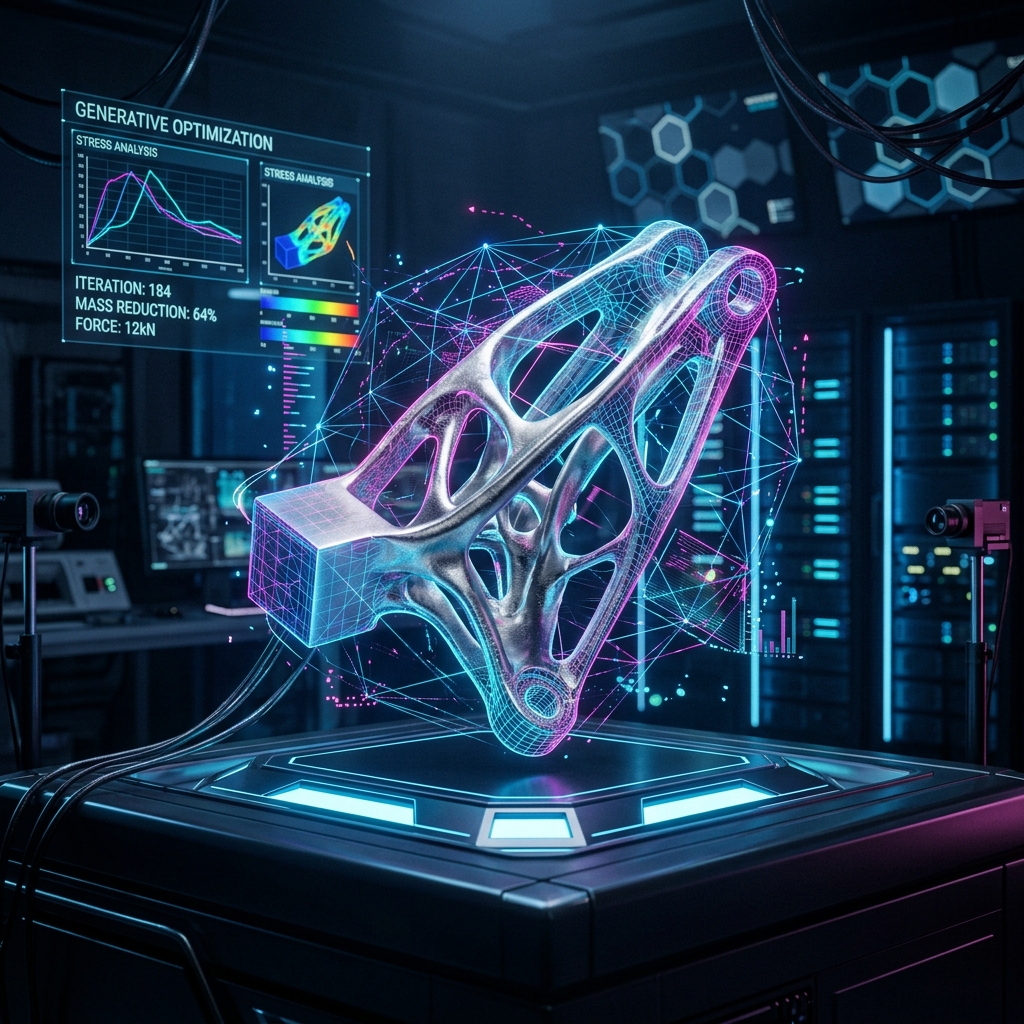
One of the most profound impacts of generative design is topology optimization. Traditional engineering often results in over-engineered parts that use excess material to guarantee safety margins. AI algorithms, however, place material only exactly where stress loads require it. This creates distinct, organic-looking structures that are significantly lighter yet structurally identical or superior to their traditional counterparts.
2. Bridging Design and Manufacturing
Early iterations of generative design often produced wildly complex shapes that were impossible to manufacture using traditional methods. Today, tools within platforms like Siemens NX, CATIA, and Autodesk Fusion 360 allow engineers to constrain the AI based on the factory floor's capabilities. If a part must be CNC milled across 3-axes rather than 3D printed, the AI will only generate solutions that meet that specific machining reality.
3. The Renechip AI-First Engineering Approach
At Renechip, we embrace the future of product engineering by integrating generative design into our core workflow. For clients in the aerospace, automotive, and heavy machinery sectors, our engineers deploy AI CAD tools to rethink legacy parts. Whether the goal is to consolidate a multi-part assembly into a single printed component or drastically reduce the weight of an EV chassis, our team provides the specialized expertise required to turn AI-generated concepts into production-ready reality.
Got a Mechanical Design Challenge? Let's Solve It Together!
Let ReneChip support your outsourcing, stocking, and supply chain needs with a practical and responsive approach.
Talk to Our TeamFrequently Asked Questions
What is an AI-powered Rebar BBS?
It uses artificial intelligence to automatically generate Bar Bending Schedules from 3D structural models, minimizing human error and saving time.
Why is it important for GCC projects?
GCC mega-projects have tight schedules and massive material requirements. AI optimization reduces rebar wastage and accelerates project timelines.
Does it replace traditional Rebar Detailing?
It doesn't replace detailers but gives them a powerful tool to generate accurate BBS instantly from shop drawings.
Ready to Scale Your Engineering Team with Elite CAD Talent?
Hire pre-vetted remote CAD designers and engineers from India to reduce costs by 40-60% while maintaining absolute quality.
Hire Remote CAD Designers