
The Critical Role of MEP Drafting and Coordination in Modern Construction
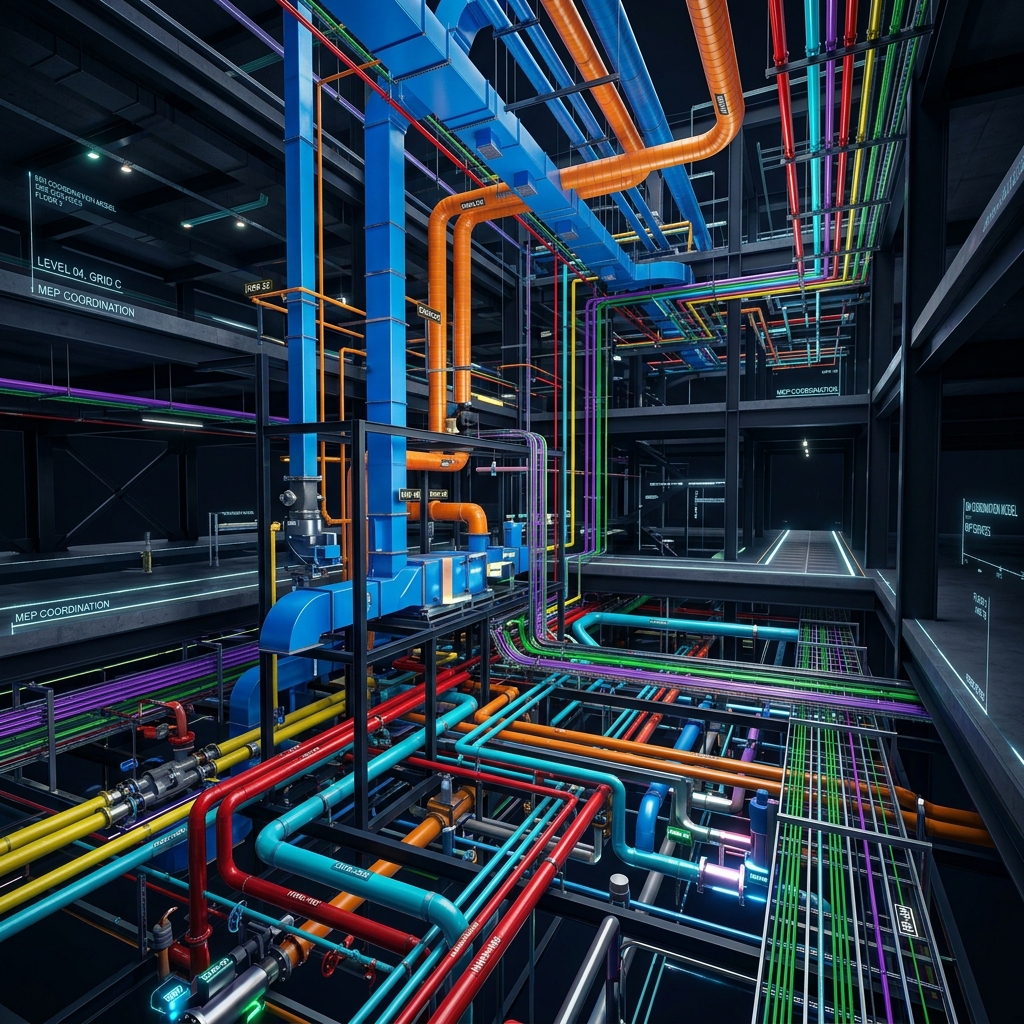
Executive Summary & Key Takeaways
- MEP (Mechanical, Electrical, and Plumbing) systems are the central nervous system of any modern building.
- Clash Detection: Early 3D BIM coordination identifies spatial conflicts before they become expensive on-site disasters.
- Cost Savings: Resolving MEP conflicts digitally reduces material waste and prevents catastrophic schedule delays.
- Lifecycle Management: Accurate as-built MEP models are crucial for long-term facility maintenance and facility management (FM).
Why is MEP Coordination So Difficult?
Direct Answer: MEP coordination involves integrating multiple complex engineering disciplines into the confined spatial parameters set by the architectural and structural design. Because mechanical ductwork, plumbing pipes, and electrical trays are often designed by separate subcontractors, coordinating them to fit seamlessly without interfering with one another is a major logistical challenge.
In traditional 2D drafting, overlaying separate DWG files often failed to capture elevation (Z-axis) conflicts. A plumber might install a drainage pipe on site, only for the HVAC contractor to arrive the next day and realize their massive duct can no longer fit in the ceiling plenum. This results in tearing out installed work, issuing Request for Information (RFIs), and delaying the entire project schedule.
1. The Power of 3D BIM Coordination
By utilizing advanced Building Information Modeling (BIM) tools like Autodesk Revit and Navisworks, MEP coordination is moved from the construction site into the digital realm. A dedicated BIM coordinator aggregates the structural, architectural, and MEP models into a single federated model. Software algorithms then run automated clash detection, highlighting the exact locations where a pipe intersects a steel beam or an electrical tray blocks a fire sprinkler.
2. Prefabrication and Off-Site Construction
Accurate MEP drafting is the critical enabler of modern prefabrication. Once a digital MEP model is fully coordinated and clash-free, contractors can extract precise fabrication drawings (spool drawings). This allows complex mechanical and plumbing assemblies to be manufactured in a controlled factory environment, shipped to the site, and installed rapidly with millimeter precision.
3. The Renechip Approach to MEP
At Renechip, we provide comprehensive MEP drafting and BIM coordination services that bridge the gap between design intent and field installation. Our engineering teams specialize in Level of Development (LOD) 350 to LOD 400 modeling, ensuring every valve, hanger, and conduit is modeled with the exact specifications required for constructability. Outsourcing your MEP coordination to our dedicated offshore experts ensures your projects stay on budget and on schedule, every time.
Got a Mechanical Design Challenge? Let's Solve It Together!
Let ReneChip support your outsourcing, stocking, and supply chain needs with a practical and responsive approach.
Talk to Our TeamFrequently Asked Questions
What is an AI-powered Rebar BBS?
It uses artificial intelligence to automatically generate Bar Bending Schedules from 3D structural models, minimizing human error and saving time.
Why is it important for GCC projects?
GCC mega-projects have tight schedules and massive material requirements. AI optimization reduces rebar wastage and accelerates project timelines.
Does it replace traditional Rebar Detailing?
It doesn't replace detailers but gives them a powerful tool to generate accurate BBS instantly from shop drawings.
Ready to Scale Your Engineering Team with Elite CAD Talent?
Hire pre-vetted remote CAD designers and engineers from India to reduce costs by 40-60% while maintaining absolute quality.
Hire Remote CAD Designers